
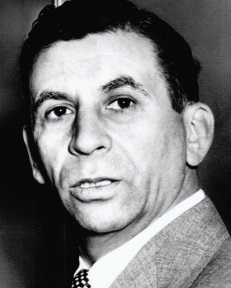
Mobster Meyer Lansky Tries to Desert USA

1970-1972 Meyer Lansky was the puppeteer behind the scenes of the world’s gambling stage from the 1930s to the 1970s, controlling and manipulating the characters, or National Crime Syndicate members, with aplomb. He capitalized on his brilliant financial acumen to develop and skim from an international casino empire — encompassing various U.S. states, Cuba, England,…

Quick Fact – Popular in Australia

1850s-Today Tuesday, April 25, Australians will be spotted throughout the local pubs playing Two-Up. Anzac Day, when military war veterans are honored, is the only time this game of chance is allowed legally. Two-Up is believed to have spread in Australia’s gold fields in the 1850s and become popular among soldiers, or “diggers” in Australian…

Bucket Shopper’s Dogged Fight

1911-1912 A San Francisco, California ordinance outlawed bucket shopping in 1911 — no  longer was running or visiting such an enterprise legal — and one operator didn’t like it. Henry A. Moss, a bucket shop owner and Nevada citizen, vowed to fight the new law, as it prohibited him from running his four San Francisco branches, which…

Quick Fact – Staying Put

1956 She wouldn’t budge. C. Johnson was playing a slot machine from a stool that was blocking the aisle in a downtown Reno, Nevada casino. When employees asked the Oakland, California resident to please shift a bit so others could pass, she adamantly refused. They offered to move the game to a spot with a…

Quick Fact – Evidence? What Evidence?

1934 When police raided an illegal gambling den in Kingston, Washington, one of the players present, Raymond Johnson, swallowed the dice. In court after his arrest, the judge gave him 30 days to “digest” and produce the dotted cubes. Unfortunately, it’s unknown how everything turned out in this case. Photo from freeimages.com: by Katinka Kober

Casino Entertains Hoover Dam Workers

1931 Twenty-six miles southeast of Las Vegas, the United States government, in 1931, developed Boulder City as the place to house men working on the Hoover Dam (originally Boulder Dam). The Bureau of Reclamation required the town to be a model community that afforded a clean living environment. To achieve this, federal legislators officially designated…

Quick Fact – European v. American Roulette

1840s-Today Gambler Francois Blanc, at his casino in Bad Homburg, Germany, introduced roulette in the early 1840s with only 0 and no 00 on the wheel and table layout, a choice he stuck with when he assumed control of the Monte Carlo in Monaco two decades later. This roulette version became the European standard. In…

Poland Seizes on Gambling

1913 During this year, the tail end of the second wave of massive Polish emigration, about 3.5 million people, primarily peasants from poor rural provinces, was taking place. Looming on the horizon was the outbreak of World War I, when Poland would become the locale for much of the Eastern Front’s operations. Gambling had become…

Club Cal-Neva Permits Horseplay

  1950 Susan Wallace, a 24-year-old, “plucky blonde” who resided in Hollywood, California, needed money to further her opera studies (Nevada State Journal, Jan. 8, 1950).  In early January, she sent telegrams to the casinos in Reno, Nevada — Harolds Club, Harrah’s Club, Bank Club, Club Cal-Neva, Palace Club, Riverside Hotel — asking if they’d…

Quick Fact – Joint Features Gambling

1916 The Los Angeles city jail was likely the only legalized casino in California, with gambling taking place daily to a shocking extent, declared Faith Chevaillier, a woman whom President Chester Arthur appointed to evaluate U.S. institutions. “There is often as much as $100 [$2,200 today] on the gambling table, and much money is lost…